Names are never neutral; as George Lamming observed, they can be powerful tools of control. In eighteenth-century literature, names like Zamore and Mirza increasingly functioned not as individual identities but as generic labels for an exoticised colonial “Other”.
A “name is an infinite source of control” (George Lamming, ‘The Negro Writer and his World’, 1956). While personal to each human being, it also becomes a social designation of one’s identity. It is no surprise, then, that the routine practice of enslavers stripping enslaved people of their African or Indigenous names and renaming them with Christian, classical, or European names shapes much scholarship of the Atlantic slave trade (see, for example, Marylise Thill, Caryl Phillips’ Cambridge: The Ambiguity of a Slave’s Identity Through Naming, 2012). This removal and replacement of naming enforced ownership, allowing enslavers to control the identity of enslaved people. Yet this is not the only circumstance of forced un-naming and re-naming exercised throughout the early modern period. When we turn to imaginative literature, we see a pattern of racial blurring; exotic names become general indicators of the abstract colonised and orientalised Other – with consequences for real-life racialised people.
“A “name is an infinite source of control”
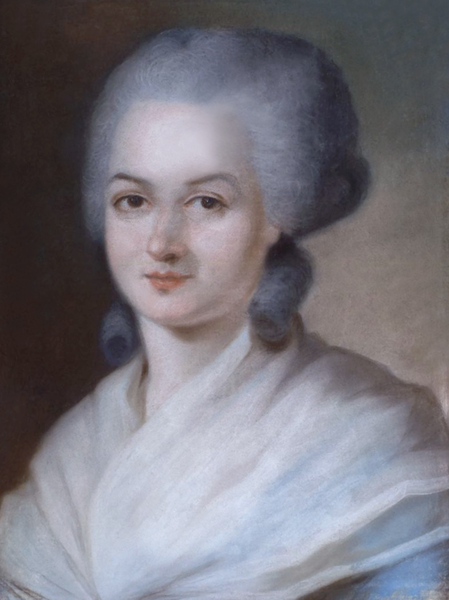
Figure 1: Alexander Kucharsky, Portrait of Olympe de Gouges (1748-1793), c. 18th century (CC BY-SA
Olympe de Gouges’ abolitionist play Zamore et Mirza, ou l’heureux naufrage (1785) is an exemplary example of how eighteenth-century texts relied on identity erasure to depict fictional enslaved characters. The original play, written in 1783/4, takes place on a colonial estate in the East Indies. The young Zamore and Mirza are noted initially as being South Asian domestic slaves who oversee Black enslaved field workers on a colonial estate. The play’s second version, written in 1788, shifts the drama to India and converts Zamore and Mirza into enslaved field workers of abstract racial identity (although they are implied to be South Asian). This process of racial blurring becomes further articulated in the play’s final version, written shortly before de Gouges’ death on the guillotine in 1792. Here, Zamore and Mirza are transformed once again into enslaved “n****s”. The play’s geographic ambiguity is often attributed by scholars to racial ignorance on the part of de Gouges. We argue that this homogenisation of racial identity is in fact a hallmark of French colonial imaginative literature; its lineage is found within much earlier iterations of ‘Zamore’ and ‘Mirza’.
We are first introduced to Zamore in Voltaire’s Alzire, ou les Américains (1736), and the name then reappears in Madeleine de Puisieux’s novel Zamor et Almanzine, ou L’inutilité de l’esprit et du bon sens in 1755. Either of these sources may have inspired de Gouges to appropriate the name. However, Zamor was also attached to real-life enslaved figures throughout the eighteenth century. Madame du Barry’s slave boy, likely a Siddi (an Indian of African descent), was renamed Louis-Benoît, though Zamor became his sobriquet. She remarks in her Mémoires that this renaming was in part “En l’honneur de la tragédie d’Alzire” (Jeanne du Barry, Chroniques Populaires: Mémoires de Madame du Barri, sur la ville, la cour et les salons de Paris sous Louis XV, n.d.). Meanwhile, at least twelve people were given the name Zamor(e) in the Port-au-Prince newspaper Affiches américaines from 1785 to 1789 to denote individuals who escaped plantations and settled in marronnages. These instances of the name reveal a process whereby Zamor(e) became a racial stock name for enslaved boys/men. In short, by the time de Gouges employed the name, Zamor had come to denote an exotic Otherness, rather than a specific identity.
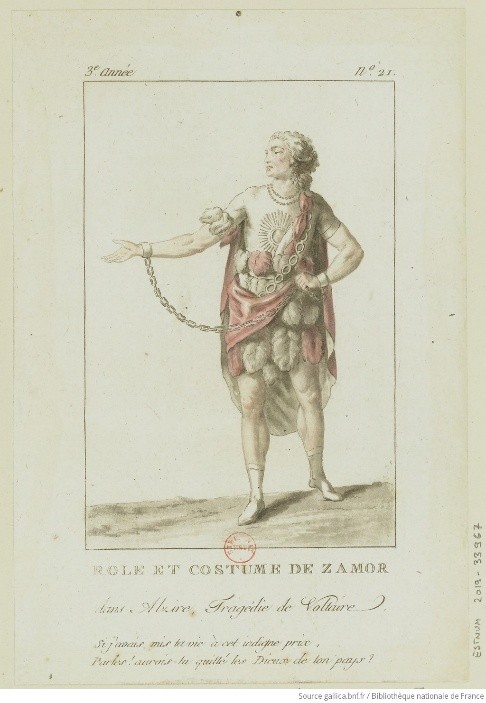
Figure 2: Jean-François Janinet, Rôle et costume de Zamore (dans Alzire, tragédie de Voltaire), engraving, 1788, Bibliothèque nationale de France. Fonte: Bibliothèque nationale de France (BnF).
Zamor(e)
| Usage of Name | Text | Racial or Ethnic Identity |
|---|---|---|
| Voltaire | Alzire, ou les Américains (1736) | Inca prince |
| Madeleine de Puisieux | Zamor et Almanzine, ou L’inutilité de l’esprit et du bon sens (1755) | Favourite emir of the sultan of Safavid Persia |
| Madame du Barry | Louis-Benoît Zamor | Likely Siddi |
| Affiches américaines | The name Zamor(e) appears in the newspaper between 1785–1789 a minimum of 12 times to label various maroons | Enslaved men of African origin |
| Olympe de Gouges | Zamore et Mirza, ou l’heureux naufrage (1785) | South Asian |
| Olympe de Gouges | Zamore et Mirza, ou l’heureux naufrage (1788) | Indian |
| Olympe de Gouges | Zamore et Mirza, ou L’Esclavage des Noirs (1792) | Enslaved African in the West Indies |
*Revised and expanded from Christipher Miller, The French Atlantic Triangle: Literature and Culture of the Slave Trade, 2008
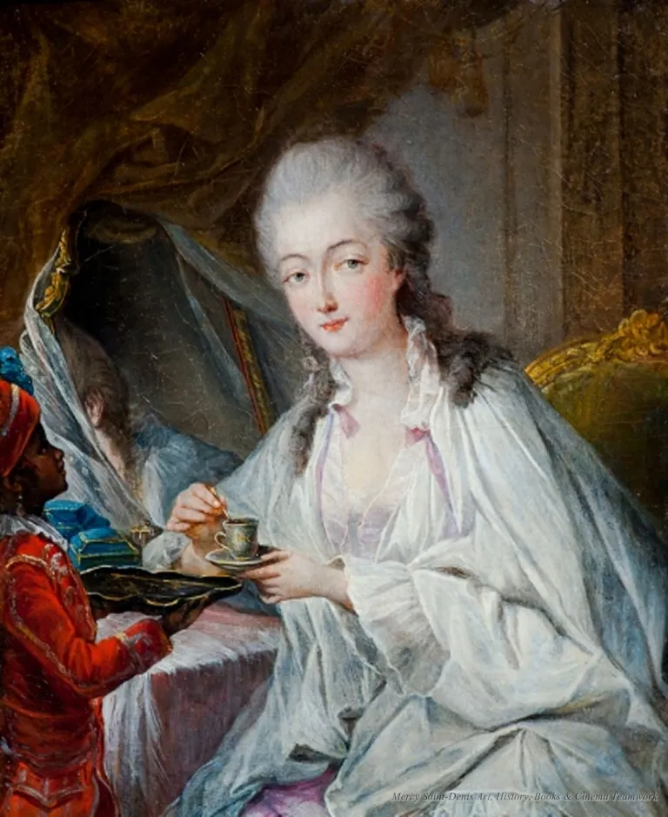
Figure 4: Jean-Baptiste André Gautier-Dagoty, Madame du Barry et le page Zamore, end of 18th century, Museu Calouste Gulbenkian
Mirza too underwent a process of racial blurring during the early modern period. Unlike Zamor(e), however, it was originally a real name, a male Persian one linked to nobility. It appeared throughout various histories of the Middle East in the seventeenth century, attributed to real-life figures, and by the eighteenth century, it entered the realm of imaginative literature.
Both Joseph Addison and Montesquieu employ the name in their Persian and Indian fantasies (Joseph Addison, The Vision of Mirza, 1711; Montesquieu, Lettres persanes, 1721). The shift in gender likely begins with Diderot’s Les Bijoux indiscrets (1748), where the similarly-styled character Mirzoza is the mistress of the Kongolese sultan Mangogul. In Louis Gauillaume de La Folie’s Le philosophe sans prétention, ou L’homme rare, ouvrage physique, chymique, politique et moral (1775), we see Mirza now firmly attached to a woman. She is probably still intended to be Persian at this point, as it is not until Gardel and Gossec’s Mirza et Lindor (1779) and its ill-fated sequel La feste de Mirsa (1781) that she crosses the Atlantic to become Creole. Mirza then becomes closely associated with prominent French writers, employed to denote both Middle Eastern, African, and racially ambiguous characters, as in de Gouges’ play. Madame de Genlis, for example, included a character entitled Mirza in Le Palais de la Vérité (1784). Germaine de Staël’s Mirza ou Lettre d’un Voyageur (1795) is another notable example where Mirza appears, now as an enslaved woman akin to de Gouges’ L’esclavages des noirs.
“Mirza too underwent a process of racial blurring during the early modern period. Unlike Zamor(e), however, it was originally a real name, a male Persian one linked to nobility.
Mirza
| Usage of Name | Text | Racial or Ethnic Identity | Column 4 |
|---|---|---|---|
| Common real name | Persian | Male | |
| Joseph Addison | The Vision of Mirza (1711) | Allegorical tale supposedly found in Cairo | Male |
| Montesquieu | Lettres persanes (1721) | Male | |
| Diderot | Les Bijoux indiscrets (1748) | Mirzoza is the mistress of the Kongolese sultan Mangogul | Male |
| Louis Gauillaume de La Folie | Le philosophe sans prétention, ou L’homme rare, ouvrage physique, chymique, politique et moral (1775) | Enslaved (likely) Persian woman | Female |
| Maximilien Gardel and François-Joseph Gossec | Mirza et Lindor (1779); sequel La feste de Mirsa (1781) | Creole | Female |
| Madame de Genlis | Le Palais de la Vérité (1784) | Middle Eastern | Female |
| Olympe de Gouges | Zamore et Mirza, ou l’heureux naufrage (1785) | South Asia | Female |
| Germaine de Staël | Mirza ou Lettre d’un Voyageur (written 1786, published 1795) | Enslaved of African origin | Female |
| Olympe de Gouges | Zamore et Mirza, ou l’heureux naufrage (1788) | Indian | Female |
| Olympe de Gouges | Zamore et Mirza, ou L’Esclavage des Noirs (1792) | Enslaved African in the West Indies | Female |
By the time de Gouges employed Zamore and Mirza in her play, then, these two names already constituted a generalised abstract colonial Other. Both Zamore and Mirza shifted from specific racial identities fixed to precise geographies and, over the course of the eighteenth century, they came to denote any colonised persons. All specificities of identity were therefore removed from these common character names resulting in a process of racial erasure not dissimilar to the renaming of enslaved people. Indeed, the fact that ‘Zamor’ became such a popular name to impose on enslaved people in the Antilles demonstrates the real-world consequences of French writers’ appropriation of these monikers.
Bibliography
- Addison, Joseph. ‘The Vision of Mirza.’ Spectator No. 159, (1711).
- Affiches américaines, nos. 11 (8 janvier 1785), 30 (23 juillet 1785), 37 (10 septembre 1785), 47 (19 novembre 1785); nos. 7 (22 janvier 1789), 9 (29 janvier 1789), 45 (15 juillet 1789), 47 (22 juillet 1789), 49 (29 juillet 1789), 51 (5 août 1789), 55 (19 août 1789), 79 (30 september 1789), 85 (21 octobre 1789), 93 (30 decembre 1789).
- de La Folie, Louis Gauillaume. Le philosophe sans prétention, ou L’homme rare, ouvrage physique, chymique, politique et moral. Clousier, 1775.
- Diderto, Denis. Les Bijoux indiscrets, ed. Au Monomota, 1748.
- du Barry, Jeanne. Chroniques Populaires: Mémoires de Madame du Barri, sur la ville, la cour et les salons de Paris sous Louis XV, Gustave Barba. Libraire-Editeur, n.d.
- de Genlis, Stéphanie-Félicité Du Crest comtesse. Mémoires inédits de Madame la comtesse de Genlis, sur le dix-huitième siècle et la Révolution française, depuis 1756 jusqu’à nos jours,. Ladvocat, 1825.
- de Gouges, Olympe. Zamore et Mirza, ou l’heureux naufrage. Chez l’auteur, 1788.
- de Puisieux, Madeleine. Zamor et Almanzine, ou L’inutilité de l’esprit et du bon sens.Hochereau, 1755.
- Gardel, Maximilien. Mirza, ballet en action, de la composition de M. Gardel. P.-R.-C. Ballard,1779.
- Gardel, Maximilien. La feste de Mirsa, ballet-pantomime, de la composition de M. Gardel.P. de Lormel, 1781
- Lamming, George. ‘The Negro Writer and his World’, Présence Africiane. no. 8-9-10, 1956.
- Miller, Christopher L. The French Atlantic Triangle: Literature and Culture of the Slave Trade. Duke University Press, 2008.
- Montesquieu. Lettres persanes. P. Brunel, 1721.
- Thill, Marylise. Caryl Phillips’ Cambridge: The Ambiguity of a Slave’s Identity Through Naming. GRIN Verlag, 2012.
- Voltaire. Alzire, ou les Américains. Jacques Desbordes, 1736.